




If your upstairs feels hotter than it should in a Texas summer, your insulation may be part of the problem. When homeowners compare blown insulation vs batt insulation, they are usually trying to answer one practical question: which one will keep the house more comfortable without wasting money?
The honest answer is that both can work well, but they do not perform the same way in every attic. The right choice depends on your existing insulation, the layout of the attic, how much air leakage is present, and whether you want the fastest upgrade or the most tailored solution.
Blown insulation vs batt insulation: what is the difference?
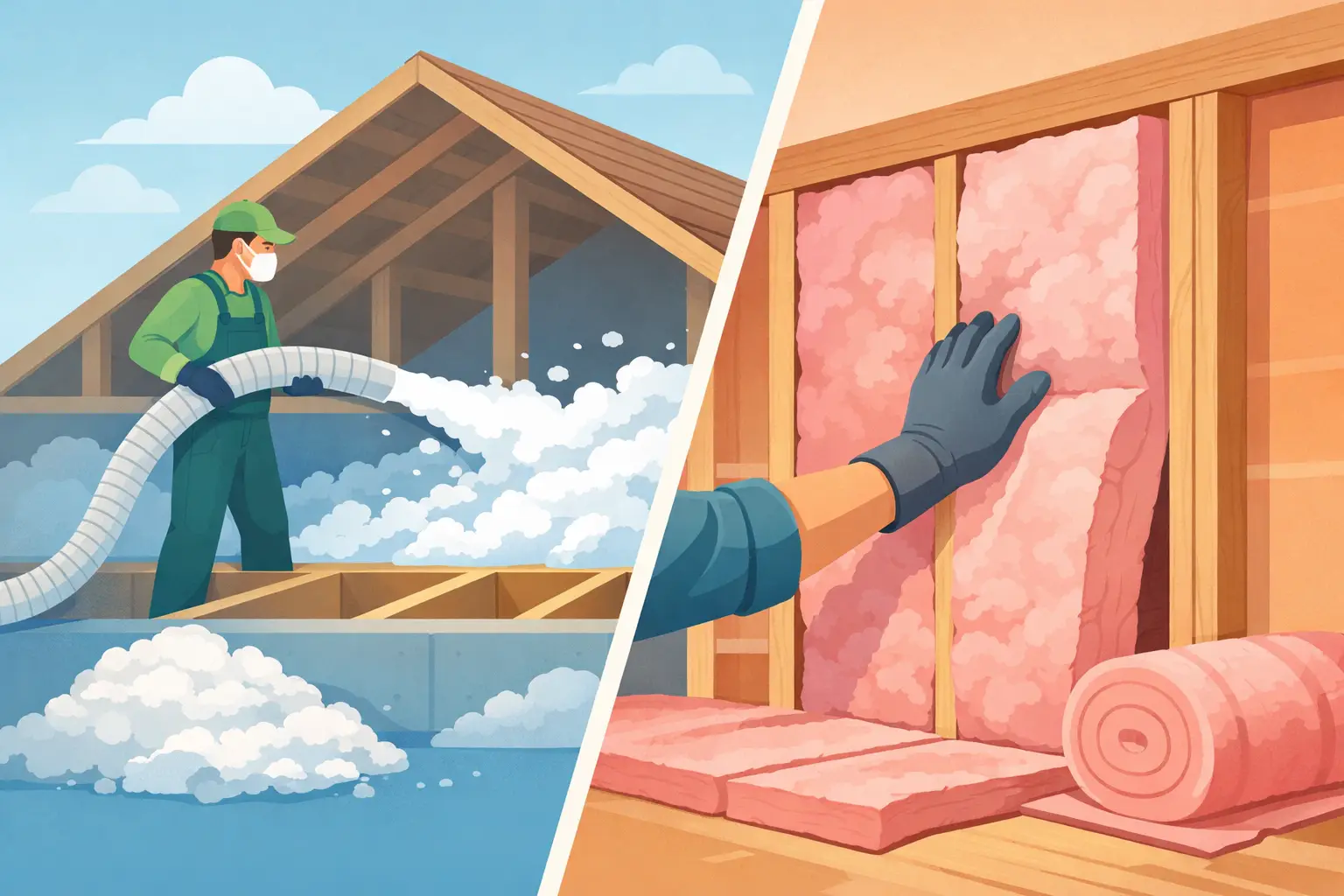
Batt insulation comes in pre-cut rolls or panels that fit between framing members. It is commonly made from fiberglass, though other materials exist. Because it comes in uniform pieces, batt insulation is often used in open wall cavities, new construction, and attics with clean, easy-to-access joist spaces.
Blown insulation is loose-fill material that is installed with specialized equipment. In most homes, that means fiberglass or cellulose blown across the attic floor to create an even thermal blanket. It is especially useful when the attic has irregular spaces, obstructions, wiring, or existing insulation that needs to be topped off.
At a basic level, batt insulation is shaped and placed by hand, while blown insulation is machine-applied and settles into gaps more naturally. That one difference has a big effect on labor, coverage, and real-world performance.
Why the choice matters in Texas homes
In the Dallas-Fort Worth area and across Texas, attics take a beating. High summer heat, strong sun exposure, and long cooling seasons put constant pressure on your insulation system. If insulation is thin, uneven, compressed, or missing in key areas, your HVAC system has to work harder to keep indoor temperatures steady.
That affects more than utility bills. Poor attic insulation can contribute to hot and cold spots, dusty rooms, allergy irritation, and extra wear on heating and cooling equipment. For many homeowners, insulation is not just about energy efficiency. It is also about comfort, air quality, and protecting the home from preventable strain.
Where blown insulation usually has the advantage
Blown insulation tends to perform very well in attics because attics are rarely perfect open spaces. There are recessed lights, wiring runs, framing changes, ductwork, and odd corners that make it hard for rigid pieces of insulation to fit tightly everywhere.
Loose-fill insulation can cover those irregular areas more completely. When installed to the right depth, it creates consistent coverage across the attic floor and helps reduce the weak spots that let heat move through more easily. That is one reason many existing homes benefit from blown insulation, especially when older insulation has settled or coverage is uneven.
Blown insulation is also a strong option for topping off under-insulated attics. If your home already has some insulation in place but not enough for Texas conditions, adding blown material can be an efficient way to increase R-value without removing everything first.
Another advantage is speed. With professional equipment, a trained crew can often insulate an attic faster than hand-placing batt after batt. For busy homeowners who want fast and efficient service, that matters.
Where batt insulation makes sense
Batt insulation still has a place, and in some situations it is the better fit. In new construction or major remodeling, when framing cavities are open and easy to access, batt insulation can be installed neatly and predictably. It is also useful when a specific part of the attic needs targeted insulation between joists or around defined spaces.
Some homeowners like batt insulation because the material is visible and familiar. You can see where it goes, and in simple attic layouts, it can provide solid thermal performance when installed correctly.
The phrase there is installed correctly. Batt insulation loses effectiveness when it is cut poorly, compressed, left with gaps, or interrupted by wiring and mechanical components. Even small voids can reduce overall performance. In other words, batt insulation can work well, but it is less forgiving when the attic is crowded or uneven.
Cost is important, but it is not the whole story
Many homeowners start with price, and that makes sense. Batt insulation materials may appear less expensive at first glance in certain applications, especially in open spaces. But labor can increase if installation is detailed or time-consuming.
Blown insulation may involve equipment and professional installation costs, yet it often delivers faster coverage in attic upgrades and can improve uniformity across the space. That can make it a strong value, not just a lower or higher line item.
The bigger question is long-term performance. If one insulation type leaves more gaps, uneven depth, or thermal weak spots, lower upfront cost may not translate into better savings over time. A less expensive installation that does not solve the comfort problem is not really the cheaper option.
Air sealing changes the conversation
This is the part many homeowners miss. Insulation slows heat transfer, but it does not automatically stop air leaks. If your attic has gaps around penetrations, top plates, vents, or fixtures, conditioned air can still escape and hot attic air can still influence the home.
That is why the best insulation results often come after air sealing has been addressed. In a real attic evaluation, the question should not just be blown insulation vs batt insulation. It should also be whether the attic is leaking air, whether the existing insulation is contaminated or compressed, and whether ventilation is working properly.
A professional assessment looks at the whole system. That matters because insulation, attic airflow, and indoor comfort are connected.
Performance, settling, and maintenance
Homeowners often ask whether blown insulation settles. The answer is yes, some blown materials can settle over time, especially cellulose. That does not mean it is a poor choice. It means proper installation depth matters from the beginning so the attic still meets the intended performance level after settling occurs.
Batt insulation can shift too, especially if it is moved during other attic work or damaged by storage, foot traffic, or service activity. Fiberglass batts that are compressed under boards or boxes will not perform at their labeled rating.
Neither system is truly set-it-and-forget-it forever. Insulation should be checked periodically, especially after roof leaks, pest activity, HVAC repairs, or years of heavy attic heat exposure.
Which insulation is better for older attics?
For many older homes, blown insulation is the more practical attic upgrade. It works well over wide attic floors, fills around obstacles, and can improve coverage without the need to custom-fit every section by hand.
That said, there are cases where batt insulation is useful in older homes too. If specific cavities are open, if portions of insulation need to be replaced in sections, or if a remodel exposes framing, batt can make sense. Some projects even use a combination approach depending on the area being insulated.
The goal is not to force one product into every situation. The goal is to match the insulation method to the attic condition.
How to choose between blown insulation and batt insulation
If your attic is open, simple, and part of a remodel or new build, batt insulation may be a reasonable choice. If your attic has uneven coverage, hard-to-reach areas, or an existing insulation layer that needs improvement, blown insulation often has the edge.
If comfort is your top concern, pay attention to coverage consistency. If energy savings matter most, look at the whole attic system, not just the insulation product. If indoor air quality and home performance are part of the picture, professional installation becomes even more important.
This is where homeowners benefit from working with a team that understands attic insulation as part of a larger home efficiency and air quality system. On Time Home Experts helps homeowners make practical decisions based on the actual condition of the attic, not a one-size-fits-all recommendation.
The better question to ask
Instead of asking which material is best in general, ask which one is best for your attic, your comfort issues, and your budget. A home with major air leaks, low existing insulation, and irregular attic space will not have the same answer as a newly framed addition with wide-open joist bays.
A good insulation decision should leave you with more even indoor temperatures, less strain on your HVAC system, and fewer surprises on your energy bill. If your home has been telling you something through hot rooms, rising costs, or year-round comfort issues, this is one upgrade worth getting right the first time.
The right insulation is the one that fits the space, solves the problem, and keeps your home safer, more comfortable, and more efficient in every season.